




Table of Contents
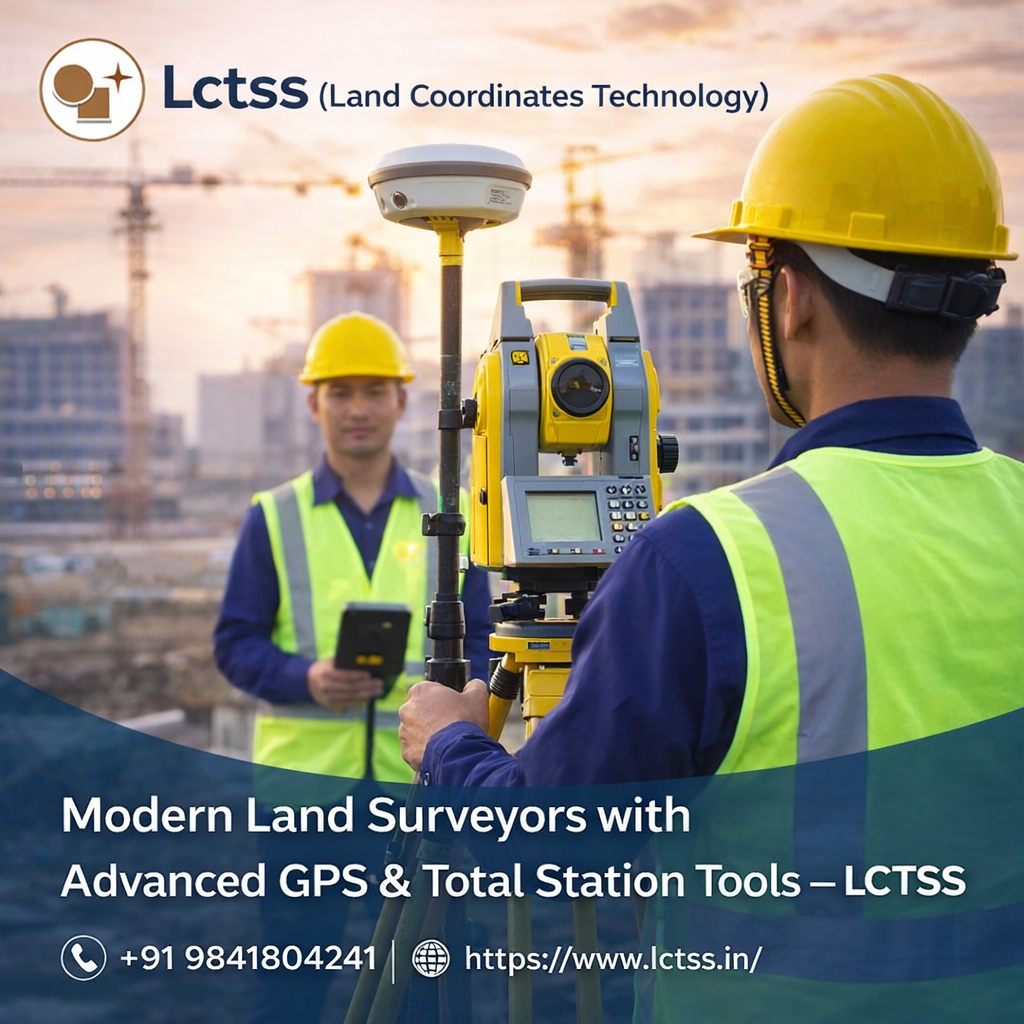
ToggleModern land surveyors play a crucial role in shaping infrastructure, construction, and land development projects. With the rapid advancement of technology, traditional surveying methods have evolved into highly precise and efficient digital processes. At Lctss (Land Coordinates Technology), modern land surveyors utilize advanced GPS systems and total station tools to deliver accurate, reliable, and time-efficient survey solutions across residential, commercial, industrial, and infrastructure projects. The integration of satellite-based positioning and electronic measurement devices ensures that every project begins with dependable geospatial data, reducing risks and enhancing project outcomes.
Surveying is no longer limited to manual chains and optical instruments. Today’s surveyors rely on Real-Time Kinematic (RTK) GPS technology to capture exact coordinates with centimeter-level accuracy. This advanced GPS equipment connects to satellite networks, allowing surveyors to determine precise land positions in real time. Such precision is essential for boundary surveys, layout marking, topographic mapping, and construction alignment. By using advanced GPS tools, Lctss ensures that land measurements are consistent, accurate, and compliant with industry standards. The data collected is digitally stored and processed, minimizing human errors and enhancing efficiency in large-scale projects.
Alongside GPS systems, total station instruments remain one of the most important tools in modern land surveying. A total station combines electronic distance measurement (EDM) with angular measurement capabilities, allowing surveyors to capture exact coordinates, elevations, and distances with exceptional accuracy. These tools are especially effective in construction layout, road alignment, building positioning, and infrastructure development projects. By integrating total station technology with GPS systems, Lctss surveyors create a powerful combination that guarantees reliable ground control points and detailed site analysis.
The use of advanced surveying equipment significantly improves project timelines. Modern tools reduce the time required for fieldwork while maintaining high levels of precision. In traditional methods, surveys could take days or even weeks to complete. However, with GPS and total station integration, surveyors can complete complex land measurements efficiently, ensuring faster project approvals and smooth construction workflows. This efficiency is particularly beneficial for large land development projects, highways, commercial buildings, and industrial layouts.
Accuracy is the foundation of successful land development. Even minor measurement errors can lead to legal disputes, structural misalignment, and costly project delays. Modern land surveyors at Lctss prioritize precision by using calibrated GPS receivers and advanced total stations to gather exact geospatial data. These instruments provide high-resolution measurements, enabling engineers, architects, and project managers to make informed decisions based on reliable information.
Advanced GPS systems utilize multiple satellite constellations to enhance positioning accuracy. By receiving signals from various satellites simultaneously, surveyors can determine exact coordinates even in challenging environments. This technology is particularly useful for rural lands, urban developments, agricultural projects, and infrastructure planning. Total station instruments complement GPS by offering accurate angular and distance measurements, ensuring detailed mapping and construction layout control.
In construction projects, precise layout marking is essential. Modern surveyors use total stations to transfer building designs from digital plans to physical ground positions. This ensures that foundations, columns, and structural components are placed correctly according to engineering specifications. GPS technology further supports this process by providing accurate reference points across large sites. Together, these tools eliminate guesswork and guarantee that structures are built exactly as planned.
Topographic surveys also benefit from advanced tools. By collecting elevation data and contour measurements, surveyors create detailed maps that represent the natural features of the land. These maps are vital for drainage planning, road construction, land grading, and environmental assessments. Using GPS and total station equipment, Lctss surveyors can efficiently gather terrain data and generate comprehensive topographic reports for clients.
Modern land surveyors equipped with advanced GPS and total station tools contribute to a wide range of industries. In residential projects, accurate boundary surveys help property owners understand their land limits and avoid disputes. In commercial developments, precise site layout ensures that buildings are constructed within approved plans and regulatory guidelines. Industrial projects rely on detailed surveys for equipment placement, structural alignment, and expansion planning.
Infrastructure projects such as highways, bridges, and railways require extremely accurate surveying data. GPS technology enables surveyors to cover long distances efficiently, while total stations provide detailed measurements for structural elements. This combination supports safe and sustainable infrastructure development. Surveyors also play a critical role in urban planning by providing mapping data for zoning, utilities, and road networks.
Agricultural land management is another area where modern surveying tools offer significant benefits. Accurate land measurement supports irrigation planning, soil analysis, and farm boundary demarcation. GPS-based surveys allow farmers and land developers to optimize land usage and improve productivity. Similarly, real estate developers rely on professional survey data to evaluate land potential and ensure regulatory compliance.
Environmental and land conservation projects also depend on accurate geospatial data. Surveyors use advanced equipment to map wetlands, forests, and terrain features for environmental impact assessments. By providing precise location data, modern land surveyors contribute to responsible land development and sustainable planning practices.
Lctss (Land Coordinates Technology) focuses on delivering technology-driven surveying solutions tailored to client requirements. By adopting advanced GPS and total station tools, the company ensures high-quality results with enhanced efficiency. Each project begins with careful planning and site analysis. Surveyors assess terrain conditions, project scope, and technical requirements before deploying appropriate equipment.
Digital data collection is one of the key advantages of modern surveying. Information gathered through GPS and total stations is transferred to specialized software for processing and analysis. This allows for the creation of detailed survey reports, contour maps, CAD drawings, and geospatial datasets. Clients receive clear, accurate documentation that supports design, planning, and construction decisions.
Safety is another important aspect of modern surveying practices. Advanced equipment reduces the need for manual measurement in hazardous areas, improving worker safety. Surveyors can measure distances and elevations remotely using total stations, minimizing physical risks on construction sites. GPS tools also allow for efficient surveying in large or difficult terrains without extensive manual labor.
By combining experience with cutting-edge technology, Lctss ensures dependable land survey services across various regions. The use of modern tools not only enhances accuracy but also builds client confidence. Reliable survey data forms the backbone of successful projects, preventing costly rework and ensuring smooth execution from start to finish.
Modern land surveyors with advanced GPS and total station tools represent the future of geospatial measurement. Their expertise, supported by innovative technology, ensures precise mapping, accurate boundary demarcation, and efficient construction layout. Lctss (Land Coordinates Technology) continues to leverage these advanced tools to provide professional, accurate, and dependable land surveying services. Through commitment to quality, technological advancement, and client satisfaction, modern surveying solutions deliver the accuracy and reliability required for today’s complex land development and infrastructure projects.